Saturday, February 18, 2006

My roots


I am native of the Northern Virginia suburbs of Washington, DC, but none of my ancestors have roots there. My father was born and raised in Gordon, a small town in northwestern Nebraska. He was the first person in his family to graduate from college. The following will explain why my Dad was born in Nebraska.

My dad’s ancestors
Granddad Bill
My father’s father William David (“Bill”) was born in Crawford, Nebraska on October 24, 1893. Bill moved with his family to Dunlap, Iowa and to Irwin and Leat, Nebraska before he married. He was employed at the Bert Hull Ranch, north of Gordon in his earlier years and loved to play baseball on the team when he worked at the Hull Ranch. He hired on as a Section Laborer with the Chicago and Northwestern Railroad in March 1915, out of Eli, Nebraska. In January 1916 he came to Gordon as a Section Foreman; he continued as Section Foreman for 30 years, until he was appointed Roadmaster for Section One out of Valentine, Nebraska (a post he held for five years until his retirement in 1951 at age 58).

Bill’s ancestry
Bill was descended from another William who came to Massachusetts on the ship “Defense” from England in 1635. Like me and many of my ancestors, this William undertook a major Odyssey relatively late in life. He was 48 years old when he made the arduous crossing of the Atlantic with his wife Mabel and children, aged six, five and two. I am descended from Ralph, the five-year old.

Four generations later, one of Ralph’s descendants, Supply, would fight in the Revolutionary War.

Pioneers of the New World
The reason that my Dad was born in Nebraska instead of Massachusetts has to do with a new religion that took hold in New England in the early part of the 19th century.

Mormon founder
One of Supply’s sons, John would become one of the earliest associates of Joseph Smith, who lead the Mormons out of New England to begin their great migration across the plains. The church was organized on April 6, 1830, and John was baptized into the faith the following September 12, one month shy of his 47th birthday. This made him one of the oldest followers of Joseph Smith. Once again, we find one of my ancestors who undertook a major new path at a time in life when most men are settling down to enjoy the fruits of their lifelong labors.

But John would never make it to Salt Lake City. Apparently he left Nauvoo with the main group of Mormons in 1846 but he did not make it to Utah, stopping in Iowa. As the Mormons moved west across Iowa, they established several semi-permanent settlements where they built cabins and planted crops. These stations provided rest and provisions for wagon trains that followed during the next few years. It was at one of these communities, Long Point, Bonaparte, Van Buren Co., Iowa that John died at age 65. This town is across the Mississippi River from Nauvoo, Illinois, where the Mormons fled during the religious uprisings that chased them from town to town across the West. His wife Rebecca died four months later in Pottawattamie County, across the Missouri River from the main Mormon camp, Winter Quarters, near Omaha, Nebraska.

Two generations of farmers
One of John’s sons was another Bill, named William Willard. He founded a little town in Iowa called Manteno. One of William Willard’s sons was George Riley, who had eleven children, one of whom was my granddad Bill.

The Irish grandmother I never knew
My father’s mother was Mae Mary. Her grandparents came from Ireland in the mid-1800s. The O’Rourks first settled in Wisconsin and then moved west to Nebraska.

My dad
His family
Granddad Bill was handsome as a young man, with steely blue eyes and a stance that proclaimed his toughness in an era of tough guys. Bill married Mae Mary on November 3, 1912 at the age of 19. My dad was born seven and a half months later, on June 14, 1913. Dad’s brother Tom was born on February 12, 1917. Mae Mary would die at home during childbirth in September 1931, when my dad was eighteen years old, a senior in high school.

My dad
My father, Emery Arnold (we share the same name) was known as a champion baseball and football player. He earned the nickname “Cy” for his baseball skills. In those days football players wore only leather helmets and almost no padding. They played on both offense and defense. Dad played center, and was known to throw his helmet off and play without one to impress a girl. He was a handsome young lad, with curly hair, cool blue eyes and a tall, muscular physique.

Dad graduated in 1935 from Nebraska State College in nearby Chadron four years later with an A.B. degree. Following graduation, he traveled to Washington, DC to put himself through law school and find work. My dad wanted more than anything to escape the lifestyle of the small town in which he was raised. I also suspect that the sudden death of his mother left him with a painful memory that he wanted to leave behind in the sandhills of the Great Plains.

My mom
My mother, Mildred Lucille, was also raised in a small town. Hers was Plant City, in central Florida. Millie came from a long line of college-educated women, including her grandmother. She also came to DC following college graduation to find work. Both of my parents wanted to escape from the small town lives in which they had been raised. This was the time of the Great Depression, and young people flocked from small towns all across the country to find work and begin new lives in the growing economy of Washington, DC.

Mom’s ancestry
Reuben Philips, Pioneer, Teacher, Preacher and Musician
My mother’s mother was Ruth Phillips, and Ruth’s great-grandfather was Reuben Philips. Reuben was born in 1795 in the frontier of western North Carolina, near Asheville. He came from a line of Methodist, Baptist and Presbyterian preachers. In those days the people of the small frontier towns had to create their own social institutions. If they wanted to educate their children, they had to find a person who could read and write, and they had to construct a building, or devote someone’s house or a church building to the purpose. Reuben Philips’ autobiography has been passed down in my mother’s family. I have held the original manuscript in my hands, and it is now in the possession of my mother’s sister, Edna Ruth Shaw. My mother’s attic contained a typewritten transcript of Reuben’s autobiography, from which I have learned much about his life.

Bringing culture to the mountains
Reuben’s father taught him how to read and write, using the Dikes Universal Spelling Book, the New Testament and the Shorter Catechism. As a young teenager, Reuben felt a calling to teach. His family was too poor to send him to school, but at age 14 he worked for a teacher in exchange for lessons in writing and arithmetic. The very next year Reuben taught his first school near the Swannanoa River, consisting of 22 students. He describes himself at age fifteen as weighing “precisely sixty pounds.” He made fifty cents per month, two-thirds of it in trade. By the time he was 20 years old, Reuben had begun to learn music from an itinerant music teacher. He caught on quickly and began teaching singing schools in addition to teaching reading, writing and arithmetic. In those days musical notation was written in what is today called “shaped note” style. By age 22, he had begun to give his young students “moral lectures,” as he calls them, and by 23, he felt the need for religion tugging at his heart. In August of 1825, at 30 years old, Reuben finally received his license to preach, or “license to Exhort,” as he puts it. During his lifetime, he traveled throughout western North Carolina, Alabama, eastern Tennessee and Georgia, teaching his singing schools, educating the children of frontier families and spreading the Gospel.

My roots are far away
The Great Depression was at its height when my parents graduated from college in the late 1930s. Like so many young people of that time, their only hope for a future was to move to the city. Washington, DC was one of the few cities that offered an opportunity for smart young people. My dad came 1,500 miles to Washington, DC, and my mom moved 900. Because my parents moved so far away from their homes, I grew up without much regular contact with cousins, grandparents or aunts and uncles. It has only been in my adult life that I have come to know about my ancestry and become acquainted with many of my relatives scattered across the continent.

Where I come from

This was written several years ago and expresses one of those "Ah-Ha" moments, where I immediately grasped the essence of my existence.

Here I sit on a park bench in Nashville, Tennessee, taking my lunch hour on October 25, 2000. I ponder who I am and from where I come.

“Do I exist only in this moment, or do I exist partly in the past? Some of my experiences now reflect back on my memories, so some of me must be in that past moment right now. How can that be? Time is a subjective experience for my mind. Sometimes it goes slower, sometimes faster. Sometimes I am caught up totally in the moment, as when playing music. Other times will find me deep in memories.

“But what of existence? Some part of me is always replacing itself. My body’s cells continuously make copies of themselves, so that in seven years every cell has been replaced. So, when do I exist, and what is the ‘me’ that exists? So it seems that my existence is defined by a set of memories. The DNA in my cells knows how to make an almost-perfect copy of itself. My neurons must know how to copy themselves, or I would lose all memories every seven years. And so I exist now, and I exist in a past time through my memories.

“And so the continuity of life is maintained through a series of memories. Memories. In the same way, I am full of memories of my ancestors. My parents’ DNA combined – just one cell from Mom and one cell from Dad. And they themselves were created by a set of instructions that knew how to make a complete copy of each of their own parents. And on and on it goes.

“So I exist in the now, and I exist in the then. And all of my ancestors exist in me. And if we go back far enough, somewhere in me are the instructions for making photosynthesis and for making a single-celled organism.

“I am one with the Universe. I am one with the past, and I am one with every experience in my life. I flow with the River of Time and with the River of Life, for they are one with me.”

Trading philosophy for a shirt, June 1999

I wrote the following to a Sioux Indian whom I met while playing on the road with a country-rock band in 1999. We spent a week at the Fort Randall Casino in Wagner, SD. )The movie, "Dances with Wolves" was filmed not far from here. The Indian had several names, which I list at the beginning. He liked our music and used to hang around drinking beer and talking with us during breaks. The guys in the band traded various things with him. I had nothing to trade, but told me about a vision and wondered what it meant, so I penned the following philosophy, for which he traded me a beautiful red shirt. He was trying to find his purpose in life, so I tried to come up with something appropriate.

Writing for a new friend:

To my friend Ben White Shoulder Horse
Sacred Butterfly
Old Man Grizzly Bear Chief
Fort Randall Casino
Wagner, SC
June 4, 1999

"A Stranger is but a friend we have yet to meet."
"All who wander are not lost."
"All that is gold does not glitter."
J. R. R. Tolkien

All living things are brothers and sisters, and the earth is our mother. We all dance to the rhythms of life on the tightrope of time.

Your vision of the half-day, half-night man signifies to me that we all have one foot in the future and one foot in the past. This man protects family, and all of Creation is our family.

God gives each of us a special gift. Our families nurture, protect and encourage us to develop our gift. As adults, we learn how to give our gift back to the universe.

In the same way, the plants draw their nourishment from the soil and produce fruits, which they share with all of their brothers and sisters. One day our bodies themselves will return to enrich the earth from which they were formed. While we draw breath, we can bear fruit to share with our brethren. Our special gift produces the fruit we share. As a man matures into adulthood, he begins to learn the nature of his gift.

God has given each of us humans the extraordinary capacity to exercise free will. This means that we may choose to withhold our gift from the world. The Bible speaks of a man hiding his light under a bushel. We can choose to remain barren or to bear fruit.

Old men and philosophers search for the purpose and meaning of life. If we step back and view all of Creation as a unified whole, we can see that all living things are co-creators with God. All life fashions existence from void, fruit from dust. A healthy plant will produce good fruit. A healthy man produces fruits from his labors. He shares these fruits with all of his brothers and sisters. In this way, he repays his mother earth and his father God for the gift of breath.

Each man and woman has a unique vision of the Truth. As we express this vision through the lens of our special gift, we produce Beauty. Artists of all kinds bear their fruit by creating Beauty. "Truth is Beauty, and Beauty is Truth. This is all ye know, and all ye need to know."

Go forth now and bear your fruit. Enrich your brothers and sisters with the special gift that God the Creator has bestowed upon you.

Your friend,

Band memories 2

After leaving Chaddy and The Echoes, I joined a group called "The Shades." I played with The Shades for a few months during my Senior year (1964) at JEB Stuart High School in Falls Church, VA. I arranged for the band to be interviewed by the Washington Star's Fifi Gorska, who produced a weekly spotlight on local bands for the Friday edition.


I'm the second one on the left. Note our uniforms. In those days band members wore identical outfits, typically suit coats and ties. The formal approach to dressing was a direct descendant from the big band era, which was not quite over. I really did have about 500 tapes of music. I recorded songs from my parents' AM radio. The tapes are still in my basement on 5-inch reels.

The Shades were based out of rival Falls Church High School (I attended J.E.B. Stuart High). My comment in the newspaper article is heartfelt:" We try to blend ourselves, our music into the people so that the beat is carried to them personally." Also the comment about playing one song right after another. That has always been a trademark of what I try to do with bands. I figure the band's job is to entertain the audience, so we must see ourselves as entertainers, not just musicians. Therefore, the more music we play the better they'll like us. This is especially true in night clubs, where you don't want to give people enough time after a song ends to start to leave for their seats. So we always tried to play one song after another with no pauses in between.

The Beatles had made their American debut, and high school bands were starting to sprout up like toadstools after a rain. But I had a bit of a head start, because I had been playing in bands before The Beatles invasion.During the summer that followed my Senior year, I played several parties with The Shades as well as with another high school band, "The Tensions."

One Friday night The Tensions had two gigs. The first was broadcast by DJ Jack Alix on WEEL (AM radio) from an ancient honky-tonk bar called Hunters Lodge in Fairfax (which was waaaay out on the boonies in those days; in 1986 it was torn down to make room for a Home Depot.)

After that gig the band caravaned out to Great Falls, where we played for an after-prom party, which didn't break up until very late. They served us free booze there, so we all got pretty loose. One of the guitar players made himself a huge strong drink of some kind; I remember seeing him gulp it down, and the next time I looked up, all that was left of him was his guitar leaning against his amp.

That was one of those parties where we uncorked ALL the dirty lyrics (40 or s0) to "What'd I Say" (e.g., "See the girl dressed in black; she makes a living on her back." See the girl dressed in green; she goes down like a submarine. See the girl dressed in yellow; you don't know it but she's a fellow. See the girl dressed in pink' she's the one makes my fingers stink.") At one point, the lead singer just said, "Lick my dick!" instead of a verse. That threw all of us into a laughing fit. I remember seeing the sun rise as I was pulling into the driveway at home.

The following September I would begin classes at The College of William and Mary in Williamsburg, VA. There I would help form "The Strangers." During the summer following my Freshman year at W&M, I would take a summer job in Ocala, FL, where I would help another upstart high school band, The Posmen, who a year later would become The Royal Guardsmen and enjoy the good fortune of a No. 1 hit with "Snoopy vs. The Red Baron."

Band memories 1

One day I shall write a book about my life playing keyboards (piano, organ) in bands. What follows in this post is a listing of a few of my early bands along with some stories. I intend to flesh all of this out with more stories, pictures and song lists - maybe even some sound clips. My intent is to convey to the non-musician what it is that compels musicians to play in bands. Some people think we do it for the money, but few of us ever earn enough to pay for our equipment. Some think we do it for the power, to meet girls or get free beer. But none of those motivations even come close to describing the experience of actually playing "live" in a band for an audience. Something magical happens, something that is difficult to put into words, but I shall try.

To begin with, here is the first photo I have of me playing in a band. This was "The Cavaliers," and there I am on the left sitting at the piano. I had taken 10 years of piano lessons by that time, but this was my first experience playing in a band. I was very nervous; perhaps you can sense my concentration and anxiety as it looks like the band leader, Morris Dubin, is about to whack me for playing a wrong note. The Cavaliers played strictly from sheet music. In later bands, I would learn how to improvise, which was a necessity, because none of the music for those bands was ever written down anyway.

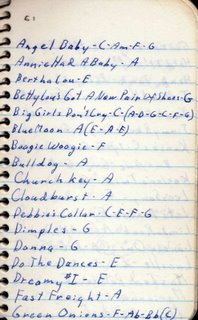
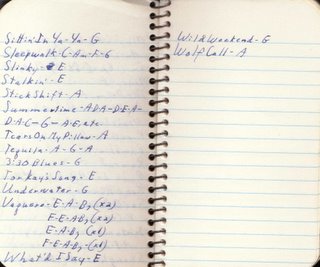
Here is the song list from "The Redlighters," my first high school band that I joined in 1963, when I was 17. You see I had little to go on but the key of the tune. I wrote down the chords in a kind of shorthand music notation and carried this little notebook in my shirt pocket. I would use this same notation until I learned the Nashville Number System upon moving to Nashville in 1998.

I couldn't tell you now what many of those songs sounded like, except that they were guitar-based. You may recognize some of the titles, like Ray Charles' "What'd I Say" and Booker T & the MGs' "Green Onions." The titles of some of the songs (e.g., "Debbie's Collar") sound ridiculous, but perhaps one day I'll research them. Most of the songs were based on the simple chord progressions of the blues, with a minimal amount of vocals. Often no one in the band could sing very well, so we played a fair number of instrumentals. Sometimes we filled up time with blues jams. These were the days before The Beatles invaded America, which was a watershed event for American popular music.

Once my band played a high school prom for Brandywine High School in Prince Georges County, MD. They asked us to play a waltz for the promenade, but the only song we knew in 3/4 time was "Gravy Waltz," a jazz instrumental. We had to slow it down to half its usual speed to be suitable for the purpose. The prom was held in the gym, which was perfect for the purpose, except that it had no electrical outlets. I solved that problem by powering the entire band from the Exit sign, using an adapter and extension cords. I always like to be prepared.

In those pre-Beatles days, bands were often known as "combos" or "dance orchestras." The big band era was just coming to an end. If you look at the Top 40 list from the early 60s, you'll see many Frank Sinatra and other big band hits on the list, and my bands played their fair share of them. (e.g., "Sentimental Journey" and "Night Train." We also borrowed from jazz (e.g., "Misty").

At first I shared an amp with the lead guitar player, who also sang through the same amp. We would drop a microphone down the back of whatever upright piano happened to be handy, and I would bang on the keys as loud as I could. In those days bands used small amplifiers (maybe 40 or 50 watts), sitting the amps on the floor in front of the players so the audience could hear. I didn't play in band with a PA system until college. My college band, "The Strangers" (1964-68) purchased a Bogen 100-watt PA system. It looked like a suitcase - the speakers clipped together, holding the amp in the middle, so you could carry the whole thing in one hand. The open-backed speakers were typically hung on the wall, but basically all the frat boys were looking for was a beat to drink to. I wish I had a nickel for every time we played "Louie, Louie." In fact, I probably did make about a nickel every time we played that song.

But I digress (or do I "progress?") Well, anyway, back to the high school years. Before too long I purchased my own Wurlitzer Electric Piano, along with its own amp. My dad drove me up to Baltimore to Jason's Music, where I purchased the entire rig for about $150 (a lot of lawn mowing for me). The back of the amp came off to make the seat of the piano bench, whose legs also clipped inside of the amp, which was about 60 watts. I played that same setup until my Senior year in college, when I traded the Wurly for a "Panther" electric organ, which was basically a cheap knockoff of a Farfisa organ. By that time (1968), pianos had fallen out of favor in pop music, and I needed the organ sound to reproduce the hits of those days.

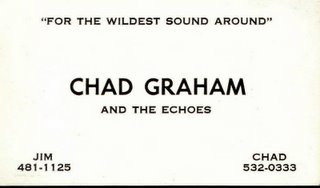
In my Junior year of high school, I played in a band called "Chaddy Graham & The Echoes." Here's our card:
That was my fist band to professionally record. We cut it at Edgewood Studios on K Street in Washington, DC. in two sessions. We put down the instrumentals first, then lead vocals, then a hand-clapping track to emphasize the rhythm. I still have the demo version, which is a metal record covered with a thin layer of plastic, into which the grooves are cut. Our two sides were "I Wanna Do It" and "Do It Anyway You Want." They played the songs over the high school PA system before classes in the morning. I remember the thrill of hearing my own music played and hearing people hum the tune in the hallway. We had visions of stardom, but shortly after we recorded those tunes, The Beatles had their first hit in the U.S. ("I Want To Hold Your Hand"). I remember us thinking that they sounded a lot like us. So we decided to hold off on releasing our song until the new fad subsided. As far as I know, Chaddy still has the old acetate master tapes.

Snow day


We woke up this morning to a newly-fallen layer of snow.
The woods behind our house had become a winter wonderland in the night
as a winter storm moved through Middle Tennessee.

Above is the view from our bedroom window.

We have eight bird feeders that hang off our deck, including one for sunflower seed, one for mixed seed, two thistle feeders, two suet cages and two hummingbird feeders that are awaiting the return of our little friends from the south. The long metal cans attached to the hangers keep the squirrels, raccoons and opossums from devouring the birdseed.

I then proceeded to set out a "bird party" of extra seed on the deck railing, which always attracts a crowd. Mr. Downey Woodpecker is feasting on the suet, while Mr. Cardinal is enjoying the seed along with a flock of goldfinches. Notice Mr. Squirrel looking for a bite in the grill.


And here's Mr. Squirrel enjoying an easy meal on the railing:

Our cat enjoys watching the wildlife too, but as soon as he saw me on the floor with the camera, he figured it was time to play.

Below is the view from our kitchen window.

After making wonderful, spontaneous love, I started the bacon cooking, toasted some homemade bread and made us an egg, bacon and cheese sandwich that we enjoyed while being entertained by our cat and the other wild creatures with whom we share this paradise.

Friday, February 17, 2006

Blurry Friday morning

It's a blurry Friday morning.

Last night I accompanied three songwriters at a local restaurant.
It was good; I played well.
My wife reluctantly came along,
and found the conversation of new good friends
and stimulating new music to be a tonic.
We didn't get home until after midnight,
and the alarm awoke me at 6:00 a.m.

Ugh.

Here I sit at my computer with my second cup of coffee
steaming by my side,
promising to jolt me into consciousness
sufficient to make it through the day.

I have an appointment this morning at 10:00
with my therapist to discuss the issue with my daughter, son-in-law
and my wife.

The question is whether or not to respond to my daughter's email
and if so, how.
I drafted an angry, self-righteous reply
that satisfied my and my wife's need
to express our indignation and disrespect we feel from them.

My daughter's email gave away her little secret.
Her husband had picked out those disrespectful gifts;
she hadn't put a second of thought
into picking out a gift or a card
for her dad's 60th birthday.

She crowed about how her husband
waded through 5000 pictures
to print out the best ones to send me.
Then emphasized that he would never apologize
because "it's too far in the past"
and I should consider the summer 2004 incident "water under the bridge."

She forgets about how her husband disrespectfully taunted me then
after ordering us out of his house upon his return
after the restraining order expired.
He mockingly said as I was packing up our things,
"You seem to be having trouble, old man"
along with many other disrespectful things
said right in front of my grandchildren.

Now I learn that he was the one
who picked out the "Old Dude" hat and the dead frog coffee mug
as "presents" for my birthday.
She thinks that bygones should be bygones,
but she forgets that he still carries a grudge
over my making them move out of my mom's house in late 1997
after I decided to sell it in order to move to Nashville.
They couldn't even pay me enough to cover the taxes on the property,
yet they felt like they had a right to stay there indefinitely.
(Mom died in late 1996.)

Now I must deal with my wife's emotions in addition to my own.
Her feelings of neglect and victimization,
memories of me not standing up for her
by not standing up to my son-in-law in 2004
when I knew that to do so would only provoke a fight.
I knew my best option was to stay silent
and let him rage.

Now in the face of this self-serving letter from my daughter,
I must once again weigh the pros and cons.
Whether to reply full of anger and indignation
or remain silent,
and allow my silence to register my refusal
to buy into my daughter's fantasy world
or legitimize her husband's continued disrespect
toward me and my wife.

Thursday, February 16, 2006

The love of a good woman and respect from a good friend

I arrived home last night around 8:15 after a rehearsal for tonight's gig.
My lovely wife greeted me as always with a warm kiss.
Those eyes looked deep into my soul,
and told me without a word that I am loved.

The Post Office had delivered a package,
a birthday/Valentine's Day present and cards
from my daughter and her twin 8-year olds.
There were cute drawings,
little Harry Potter Valentines from the kids
and many great pictures of the kids, my daughter
and a few of the family including her husband.

Also included were a black baseball cap that said, "Old Dude - made of Achy, Breaky Parts"
and a coffee mug that said, "Old Croaker" complete with a caricature of a dead frog.
I put on the hat and mumbled, "huh."
My wife inquired, "What's bugging you?"
to which I replied, "Nothing, dear. I'm just tired from practice and hungry for supper."

But she persisted, insisting that she could tell something was wrong.
Finally she said, "You're disappointed, aren't you?"
I finally admitted, "Well, yes - I suppose I am."

Those gifts weren't meant for me.
They were meant for another person.
Someone who's dying physically and mentally.
Someone who's not me.

I may be 60, but I'm anything but falling apart.
I've been doing Jazzercise for 18 years;
I'm at my mental and creative peak.

Also on the table was a birthday card from a mutual friend.
Her card expressed true sentiments;
acknowledged me for being a good friend
over the two and a half years we've known one another.

Then it hit me.

Here is someone I've only known since 2003
who knows me better than my own daughter,
to whom I gave the breath of life.

Someone who's not related to me
actually understands the gifts I offer.
The gifts of trust, honesty, friendship
and sometimes help with maintaining her car.

My wife and I rescued my daughter
from a domestic abuse situation in the summer of 2004.
After receiving her frantic phone call in the middle of the night,
we pulled up stakes and made the 13-hour drive to her house.

He had hit her.
She had filed a report with the police,
and he spent that night in jail.
The judge issued a 72-hour restraining order.

She was scared for the safety of herself and her children.
Upon her request I accompanied her to the court house the next day
to fill out papers for a permanent restraining order
and child support.

But the next day she let him back in the house.
Her husband stood toe-to-toe with me,
spoiling for a fight
and angrily ordered us out of his house
in front of my grandchildren.

Since then according to my daughter, they've "patched everything up."
But I've heard nothing from him.

For months I called her every week,
inquiring if everything was okay.
She was polite and even friendly on our phone calls,
filling me in on the kids' activities
and sometimes describing things she and her husband had done together.

On one of my last phone calls
I reminded her that her husband's actions
precluded us from visiting them again
until he apologized for his behavior toward me and my wife.

I reminded my daughter of the pain it caused me
to know that my wife and I are separated from my own grandchildren,
whom I may never see again.

That we had responded to her desperate call for help.
Dropped everything,
missed my 40th High School reunion
to stand by her side in her moment of need.

and that now I felt discarded,
used,
thrown out.

and my wife feels used and abused,
frightened of the monster that my daughter married.

I wanted to make it as clear as possible
that we had responded to HER call for help,
and now we are paying the price.

She refused to have her husband call me.
Said he doesn't like to talk on the phone.

So I suppose she thinks it's up to me
to call him and...

what?

Apologize?

Of course my daughter is in denial.
Maybe she wants to believe that the incident simply didn't happen.
Maybe she wants to believe
that her husband didn't really say the mean, nasty things
that we all heard come out of his mouth.

Maybe she just wants to escape the awful reality
that she is married to an abuser,
and that she refuses to leave him.
Maybe out of fear,
maybe out of laziness.

She busies herself with babysitting three other children,
teaching voice students,
singing professionally
and raising twins.

Some day her busy world will stop,
and she will realize that she has discarded the love
of the one man on earth
who had more to give her
than anyone else.

Her own father.

And so as these thoughts cascaded through my mind last night,
my wife sat by my side,
her eyes filled with understanding and love.

She knew already what I at first didn't want to admit.
That I had been betrayed once again.

But I felt a greater reality,
the reality of her love.
Her abiding, unflinching love for me.

To be known and loved by a good woman,
to be respected and admired by a good friend,
these are the true gifts of a life well-lived.

Wednesday, February 15, 2006

Remembering a long and memorable Valentine's weekend

It was a long and glorious weekend of love.

We packed on Saturday, attended the early service Sunday morning and then after a quick lunch headed eastward to Fall Creek Falls state park. We took old U.S. 70 much of the way, which allowed us a more leisurely view of the countryside. During part of our journey we listened to one of the tapes from "Co-Dependent No More" by Melodie Beattie. As we drove along, the gently rolling hills of Middle Tennessee gradually gave way to the more mountainous topography of Eastern Tennessee. When we arrived, the park was blanketed in a fresh layer of snow, which continued to fall throughout Sunday night. It was a "perfect storm" in that the temperature didn't fall low enough to make roads slippery, but did allow plenty of snow to cover everything. We visited the famous Fall Creek Falls Monday afternoon and again Tuesday morning before leaving. We took plenty of pictures of the 256-foot cascade, which is the highest waterfall east of the Mississippi.

We checked into our cabin about 4:30 p.m., where I was successful in hooking up our XM Satellite Radio receiver to a boom box for constant non-commercial musical enjoyment. Sunday night was a full moon, which was obscured by the clouds; however on Monday night we got to see it rise over the lake.

We stayed in a "Fisherman's Cabin," which is built right out over the lake. It has a full kitchen, central heat and a wall of glass windows on the lake side that bathes the cabin in light during the day. Ducks and Canada geese swam up to (and under) our deck, beckoned by our presence for a possible handout (they were not disappointed). Monday night we took pictures of the full moon and the 2+ foot-long icicles that dangled over the water from the cabin roof. Shortly after we arose on Tuesday morning I saw most of them fall into the lake.

We stopped by Cookeville on our way to the park Sunday afternoon for provisions. That night we warmed up a turkey breast, my wife prepared stuffing, and I fixed us a salad. We watched a bit of the Olympics, but pretty much spent our time there without watching much TV. Monday night I broiled a steak in the broiler instead of attempting to barbecue on the outside grill, which was covered in snow. This was the first time I've broiled a steak in the oven; it was delicious! We also made a chocolate cheesecake Monday afternoon for my birthday (which was Tuesday - that's right - Valentine's Day). A friend of my wife sent her the recipe, which was simple and scrumptious.

Late Monday morning we drove up to Cookeville for an hour-long couples' massage, then had a quick lunch at a forgettable eatery (the "Soup Kitchen") before returning to the park for an afternoon of picture-taking. We drove the scenic loop that includes a stop at Fall Creek Falls, where we took lots of pictures. The sun was low in the sky by that time, giving us some great angles and interesting light on the newly-fallen snow. We visited the falls again Tuesday morning on our way out. My wife hiked with me down several snow-laden trails; I'm quite proud of her!

Tuesday after checking out, we traveled again up to Cookeville and this time had a memorable lunch at Bobby Q's barbecue. I highly recommend it.

Shortly after arriving home Tuesday afternoon, we changed clothes and headed out to a couples' seminar at the University School of Nashville, taught by practitioners of Imago. After "meet & greet," the couples were instructed how to perform two exercises. One was called "dialogue" and consisted of one person telling the other a specific thing they appreciated about the other person. Then the person hearing would repeat what the other person had said to them (this is so they would "take it in), and then say "You're welcome." This is the hardest part - it's easier to come back and say "Thank you" when some one appreciates something about you.

The second exercise was called "positive flooding," and I enjoyed it the most. One person sits in a chair, while the other one circles closely, talking to the seated person. You cover three areas in 30 seconds each: Physical, Emotional/Behavioral and Closing. While you are in front, you make eye contact, and during your talk you maintain physical contact with the seated person. During the physical part, you tell the person all the physical things you appreciate about her/him. During the emotional/behavioral part, you tell the person the aspects of her/his personality and behaviors that you most appreciate. During the closing, you have a "big finish," saying something like, "You're a goddess, and I worship at your feet." That's what I said, anyway.

Afterwards, filled with even more positive feelings about one another, we headed to a little Mexican restaurant near where we live, then headed home to relax on the couch for a little while before collapsing into bed, physically spent but emotionally fulfilled by our days and nights of love.

And yes, we did make love - a lot. It was fabulous.

Friday, February 10, 2006

Anticipating a long Valentine's weekend

I reserved a cabin for my wife and I on the lake at a beautiful state park for Sunday and Monday nights. We'll leave Sunday after church and take a leisurely cross-country drive (133 miles). We're supposed to get snow tonight and tomorrow, so hopefully we'll have a Winter Wonderland to enjoy. The park has many beautiful waterfalls, which should provide (weather permitting) ample opportunity for great photos.

I also reserved a couples' massage for us in a nearby town for Monday at Noon.

We're looking forward to a relaxing two days filled with making love, solitude, reading, making love, listening to music, sleeping in late, making love and making breakfast together.

Did I mention making love?

The cabins have only dial-up Internet, but the park lodge has wireless Internet, which will allow us to check email and so forth but not allowing the computer to suck away our attention in the cabin. Otherwise, the cabin is equipped with a full kitchen, VCR, cable TV and even a wood-burning stove (with wood supplied). The lodge has a big fireplace, where they keep a fire burning during the winter, and it also has a restaurant. It's full during the weekends, but we should pretty much have the park to ourselves on Monday and Tuesday.

Upon our return on Tuesday (Valentine's Day, which is also my 60th birthday), we are scheduled to attend an evening seminar on love at Vanderbilt University.

Lots 'o love coming our way!

The march of culture

Today is tomorrow's yesterday.

Each day human culture grows a new skin.
New music,
new clothes,
new words,
new ideas,
new identities.

Youth are always the vanguard.
Their clothes, hair and tattoos body piercings
revolt the older generation.

But it has always been thus.

In my generation
it was ducktails and pompadours,
penny loafers, saddle shoes and poodle skirts,
big hair, collars turned up,
taps on shoes,
black shoes with white socks.

Today it's hip-hop and house music.
In my day it was Bill Haley, Chuck Berry, Elvis and Jimmy Reed.
Each in their own way offended the parental generation.
New ways of talking constantly evolve and perplex the older generation.
In my day it was "cool and hip;"
today it's "Whassup" and others I don't even know
because I'm not privy to those secrets
and my own children are approaching middle age themselves.

I realize I'm now a part of the older generation,
even though I haven't lost my sense of rebellion at the Establishment.
That's one thing my generation did right.
We rebelled at civil rights injustices, promoted equality for women
and forced a reluctant nation
to confront the awful fact that Vietnam
was an unjust and unwinnable war.

Sound familiar?

But this isn't a political rant;
it's about the constancy of social change.

However, it's easy to throw the baby out with the bathwater.
As opaque as the exterior of each generation may appear to its parents,
we're all still the same.
Young people are still searching for their own identity,
determined to break free from the old mores of their parents
as their parents struggle to understand them.

But remember, all parents were once children themselves,
buffeted by the winds of change in their own way.
As my generation struggled with the Draft,
My parents' generation struggled with the Great Depression
and World War II.

These forces shape the generations,
as the generations in turn shape those forces.

Maybe what the older generation can offer is perspective.
We've seen it all come and go before.
We've rebelled, been rebuffed and have also succeeded.
We've been alive long enough to witness the turning of the Wheel,
whereas our younger friends may still be caught up in the moment.

This is how Wisdom is gained.
Observation,
victory,
defeat,
joy,
sorrow.
All carve the furrows of experience
into our souls,
allowing them to fill with knowledge
that can ripen into Wisdom
given the perspective of time
and reflection.

Thursday, February 09, 2006

Finding Flow and goals

I am reading the book, "Finding Flow" by Mihaly Csikszentmihalyi.

Here's an excerpt from one review:

`What is a good life?', is basically the question addressed by this book. Well, isn't a good life just about being happy? Ok, but that is not the complete answer. For how do we become and stay happy? Not by watching TV, eating, or relaxing all day! In small doses these things are good and improve your daily life, but the effects are not additive. In other words: a point of diminishing returns is quickly reached. Also you don't become happy by having to do nothing. Csikszentmihalyi's research shows that both intrinsic motivation (wanting to do something) and extrinsic motivation (having to do something) are preferable to not having any kind of goal to focus your attention.

Last night I started reading the section on the importance of having goals, and I realized that for most of my life I have simply stumbled from one day to the next without any long-term goals. I have set goals at times, such as my goal to move to Nashville to see if I could "make it" in music, and my recently achieved goal to create a comprehensive database of decisions made by my agency.

But long-term goals? What are they? How would I recognize one if it hit me in the head?

Maybe just surviving each crisis has seemed to sap my energy. But many of my crises in the past have resulted from not having a goal in the first place and simply picking the path of least resistance. For example, I started my 29-year career with the Telephone Company in 1969 in the shadow of the Vietnam War, when I was desperate to find a job to sustain my new family (wife was pregnant with our first child when I got an early out from the Navy).

And I just stayed. No particular passion for the phone company - it was just a safe, decent-paying white collar job that happened to be in the area where I grew up. And I've always had a knack for corporate survival. I'm a smart people-pleaser, so I've always found ways to be useful.

But after working for the Telephone Company about eight years, I found myself in an intolerable job. I felt like I was in a box and had no options. My family (wife and kids ages 5 and 7 at that time) depended on me. I felt like I had no transferable skills, since I had worked very specialized jobs that only exist in the Phone Company. I even contemplated suicide, but this was not feasible, because so many people depended on me. So my short-term solution for making a living ended up biting me in the ass, because I found myself in a job that was not of my own choosing and that was driving me crazy. Those were the years of anti-depressants, Valium, Librium and Probanthene. But I stuck it out, managed to change jobs and finished out a long career in 1998.

Stepping back a few years, why did I marry my first wife? Did I even know who I was then? Was that relationship just an attempt to escape from a repressive family of origin into some kind of independence?

Of course I made it work - we stayed married for 26 years and raised two wonderful children, who now have given me four wonderful grandchildren.

But that choice of marriage partner, like my career choice, also lead me toward ultimate disaster. Our relationship grew increasingly toxic, because we grew increasingly apart from one another. We found we had nothing in common after the kids left the nest. Our initial motivation, to escape from our parents' family, quickly wore thin once we had established our own family. So my goal then became to simply stick together for the purpose of raising our children. I now know that my first wife stopped loving me quite early in our marriage.

So it's not like I can second-guess myself and wish for a different history. I am what I am, and I did what I did. I'm actually proud of myself for getting and keeping a good job, providing for my family and keeping our marriage together for the sake of our children. I'm just reflecting on my general lack of goal-setting behavior.

And so it is with my current job. I came to Nashville for the music, not for the day job I now hold. It's a great job, one that offers me challenges and at least psychic if not huge monetary rewards. But it supports me and my wife, and I'm grateful to live in such a great city in such a comfortable house in such a beautiful area. But that's not the point. The point is that I jumped at this job because it was available, and I desperately needed a job after 1 1/2 years of unemployment following my retirement from the Telephone Company in 1998.

Now retirement looms just six years away, when I'll be able to draw full Social Security benefits.
Thus I may have my first opportunity to really set some goals for myself.
What kind of goals?

Writing poetry, prose - telling all the stories I have to tell
Photography - my new passion discovered thanks to a good friend's father/
Genealogy - I want to tell the stories of my ancestors
Music - playing, writing, recording
Travel - see interesting places

One choice of which I can be proud is my wife. I deliberately set out to find her following the untimely death of my second wife from leukemia. I was looking for someone intelligent and passionate, someone who appreciated music like I did, and someone who could see the world through similar eyes. I wanted to find someone who could actually relate to the REAL ME, not some projection of her Perfect Man.

Now I have found her, and she has found me.
She understands my soul.
I see into her soul.
We are soulmates.

Now I finally know what Real Love is.

Winter Wonderland, Geology and Psychology

I awoke this morning to a winter wonderland. The rising sun flooded snow-covered branches, raising a spirit of joy somewhere deep in my soul.

We live on the "Highland Rim," which is an elevated plateau north of Nashville. The plateau is about 500 feet above the rest of Middle Tennessee, so we sometimes get snow while only rain falls just a couple of miles south.

The Highland Rim is actually the edge of a geological bowl in which Nashville sits, which is called the "Nashville Dome." You might wonder why a bowl would be called a dome. The reason is that this area was uplifted by tectonic forces during the Late Devonian period (354 to 370 million years ago) and then again during the Carboniferous Period (286 to 360 million years ago). A glance at any major road cut in Middle Tennessee will reveal layers of limestone, which is brittle in nature. These uplifts caused this brittle limestone to crack, which allowed erosion to remove about 500 feet of material, causing the surface of the dome to recede below the surrounding area. The Cumberland River and its tributary carried this material eastward toward the Mississippi. Thus the Highland Rim remained elevated above the lower areas such as Nashville. The rocks on which Nashville sits date from the artificial (443 to 490 million years ago), whereas those of the Highland Rim are younger.

I've always been fascinated by geology, which was one of many potential majors I might have chosen in college (I graduated in 1968). I could also have majored in English, Sociology, Anthropology and Philosophy, but I chose Psychology instead. I didn't choose my major until the 11th hour, at the end of my Sophomore year after taking just one Psych course, Abnormal Psychology. This introductory course was intensely fascinating to me, but it turned out that William & Mary's Psych program was what they call "Experimental" instead of "Clinical," which is the other main type of undergraduate psychology.

So after one very interesting introductory course, there were no more like it. Instead, I had to learn how to manually calculate R-squared, T-tests for significance, etc (and I'm terrible at math). I gathered statistics on how quickly rats could be taught to press bars and how quickly this behavior could be extinguished, along with studying other simple behaviors. Very boring, nothing new, nothing of interest to me, since my primary reason for choosing Psych as a major was to learn about human behavior, not to replicate experiments that had been performed decades ago. I did enjoy playing with my rat, however.

Another major aspect of the program was learning how to publish articles in professional journals. It seemed to me like the purpose of W&M's undergraduate Psych program was to prepare a student for a Masters and later a Doctorate degree, the only purpose for which was to become a Professor in order to train new Psych teachers, who would train other Psych teachers, etc.

It also seemed to me like Psychology involved in a desperate attempt to prove itself a "real" science like Biology and Physics; hence the emphasis on replicating experiments to establish scientific proofs. I later learned that other colleges focused on Clinical Psychology, which studies human behavior instead of focusing on experimental results and publishing. I might have actually pursued that field if I had chosen a different college. But you can't live life in the rear view mirror.

Wednesday, February 08, 2006

Work triumph

Today I presented a summary of a major accomplishment at work that I've been preparing for over a year. It will help everyone in our agency, and it's something I invented myself. No one asked me to do it; I just undertook the work on my own and created a search and reference tool for everyone. I love doing things like this. Although they may me garner some measure of professional respect, there's no possibility of a promotion or raise, because I work in state government. It's completely altruistic - a little like donating blood (I've donated over 18 gallons to the Red Cross in my lifetime).

What makes work worthwhile?
Is it the monetary reward?
Is it the companionship?
Is it doing what you're told?
Is it the respect?

After more than 34 years in the work force, those memories I cherish most are of the projects in which I was able to completely invest myself. The things that have given me the most pleasure are those that I was able to undertake on my own initiative, or at least provide significant creative input. Very few of my work colleagues from former jobs have kept up with me, and the money I've earned has gone to pay my bills. Doing what I'm told only keeps me out of trouble. Respect is nice, but you can't spend it.

My creative impulse keeps me going.
It keeps me interested.
I need a challenge,
something that other people can't do,
something into which I can pour my heart and soul.

If you're reading this blog, you obviously know that I need a creative outlet.

Now that I'm done, I feel like goofing off the rest of the day.

After work I leave for a rehearsal with three singer-songwriters whom I am accompanying at a gig on Feb. 16th. I hope it doesn't go very late, because I badly need to love my sweet wife who will be awaiting my arrival with open arms.

Tuesday, February 07, 2006

A single ray of sunshine

This morning as I sat at the breakfast table,
a single ray of sunshine blasted through the front door glass,
flooding my hands on the table
as I wrote a love note to my dear wife
sleeping in the bedroom.

In the same way, the deliberate steps we have taken recently
have begun to illuminate some dark recesses of our souls
previously unavailable for inspection
and therefore unknown.

Fear of the unknown is the worst kind of fear,
and when the unknown is inside you,
it creates a toxic brew of confusion and anxiety.

All my life I have struggled to understand my insides.
Raised in a family that prohibited the honest expression of emotion
or the discussion of important personal issues.
Rarely rewarded for good behavior,
Mostly punished for bad behavior
or the failure to live up to potential and expectations.

I learned to grow up by myself,
become self-reliant,
never trust anyone,
always show the smiling face.

Never a mentor,
never a trusted confidant
other than my dog,
the only one who could not betray.

Men are not to be trusted,
men are angry and violent,
competitive and narcissistic,
manipulative and power-hungry.
They will beat you down,
chew you up
and spit you out.

Women are crazy,
likely to go off at any moment
with or without provocation.

One must protect oneself from these slings and arrows,
One must care for one's poor retarded sister,
One must care for one's poor widowed mother,
One must care for one's poor depressed wife,
One must care for one's poor sick wife.

But where in this mix is the Self?
Is the Self only something to be guarded and protected?

How and when does the Self find its expression?
In writing,
in music,
in love.

How can the Self learn to sing?
How can the Self find its center?

Can a single ray of sunshine start the process?

Monday, February 06, 2006

Nightmare

Nightmare
The other morning I awoke early from a nightmare. I think it was very early Saturday morning.

I had heard men's voices inside the house and awoke (in my dream) to find my wife in the hall with the men. I immediately got out of bed to see what was going on, but since I had shown myself to the intruders, I realized that I could not dial 911 now because they had seen me. I awoke in fear and did not go back to sleep for fear of re-starting this dreadful dream.

I believe this was early Saturday morning.

Friday night I played with the church classic rock band at a fundraiser for the youth program. We set up inside the church in the social area. I was crammed into a corner formed by stone walls and a glass door to the outside where it was cold and raining. Eventually four guitar players showed up, each with their own amplifier. At any one time the band had two keyboard players, a bass player, four guitar players and a drummer. By the end of the evening, the din had grown so unbearable that I went to bed that night with my ears ringing. When the sound is so loud, I cannot make out any musical tones - it all just sounds like sonic mush. I even played an entire song in the wrong key and only realized my mistake after the song was over. This of course was mortifying to me, the professional keyboard player.

It was a cold, rainy night. The rain pelted down all evening, and the temperature hung in the low 40s. At the beginning I dragged my keyboard rig (about 200 lbs. In several large pieces) down the stairs and set it all up. After the gig, I packed it up and carried it out the back door near where I had set up and loaded it into my van. This way there were no stairs to negotiate, but the way was dark, and the path was strewn with large stepping stones, roots and other things that are easy to trip on. My shoes and coat were soaked when I got into the car to come home.

We did a sound check and rehearsal at 5:30, then around 6:15 everyone but me split to go home, eat supper and change clothes. I had already grabbed a sandwich on the way from work, which I consumed after the rehearsal. Home is a 45-minute drive in rush hour, so there was no point in making that round trip.

I felt very awkward after the rehearsal and before we started playing. There was no purpose in my being there except to play music. The only other people in the building were the kids and youth group leaders, who were setting up for the evening's festivities. I know none of them, except by sight. I know I've been introduced to many before, but I have a terrible memory for names, and I have nothing in common with any of them, so what would I have to talk with them about? I decided to get a cup of soda to go with my sandwich. It's hard to describe how I feel in such situations. "Invisible" might be one description. "Mute" might be another. I find myself coming up with these fakey smiles and nodding of my head as if I knew people or actually felt like being there. I don't even know how to talk with people; it's a struggle to just ask for something simple like ice or a soda. I realize how stupid this sounds. It even sounds stupid to me. It's hard to write about it, because I realize that it doesn't make any sense. Maybe such situations activate old neural pathways of my childhood, when I always felt different (and therefore inferior) from the other children. Maybe I still feel different, and maybe that's a good thing most of the time, because I do treasure my individuality. And I've grown to understand that "different" doesn't mean "inferior."

After finishing my sandwich I sat in a pew for awhile, gazing at the photographer's backdrop that had been set up to take portraits of the kids in their formal wear.

I decided this was a good time to write in my journal, so I got it out of the car and sat there scribbling for maybe 45 minutes.

This is an open-invitation band; anyone is allowed to play. The leader is the other keyboard player, and five or six people sing lead, although there are usually no more than three singers at a time. It's a little like the "Monkeybars," as my basement group in Northern Virginia called themselves.

I've played an entire gig only once before with this group, in October at a retreat. We set up in a large room with wooden floors and a high ceiling, where the sound wasn't deflected back on us. I don't think I want to play with them again under the circumstances of last Friday.

No one but my wife knows how I feel about this.

My "feel sorry for me" side doesn't want anyone else to know how I feel, because somehow I think I would have to justify how I feel. A part of me likes to suffer in silence. What's that about?

When I returned home Friday night, my wife and I got into a difficult discussion after I revealed to her how I felt about the evening. She said I was just being a little boy who wasn't happy unless he was in charge of everything. She also said I would have had a good time if she had been there. Is it passive-aggressive behavior for me to tell her how I felt? If so, how can I acknowledge my actual feelings without hurting her? Wouldn't it be manipulative for me to select out which feelings I should reveal, based on what I thought her reaction would be?

It is true that I would have enjoyed myself much more if she were there, but the issues with the sound, the rain and the cold would have been just the same. And I would still have felt like and outsider, one with little to offer. I mean, how many lead players do you need in a band? The kids certainly deserve their chance to shine by playing lead in front of their contemporaries, and the adult players do too.

This whole thing turned into a tangled and confused mess.

I know that we're over the problems we had on Friday night, and now we can discuss this dispassionately.

I almost forgot that this post began with a nightmare. What did it mean?

Maybe the men who invaded our house symbolized my own fears of our life being invaded somehow by outside forces, such as the band or anxieties caused by outside stressors. I don't know if that makes sense or not, but I hate when my life is invaded by forces not of my control.

Maybe the men represented the band that invaded my sonic space. I really hate that; I've spent 44 years playing in too-loud bands and have gone home on too many nights with my ears ringing, sometimes still ringing the next morning.

Or maybe it was just a nightmare.
Who knows?

Reflections on modern society

Reflections on modern society:
While watching the Super Bowl commercials yesterday I reflected on some of the currents of modern culture. We are so interconnected, but at the same time so ignorant. News screams at us from every portal imaginable, but so little of it has anything to do with our lives. We are titilated at every turn by horrific stories of murder, torture and unspeakable horrors. We all seem to be adrenalin junkies. It was not always thus. I grew up in the age where kids played outdoors and only consented to indoor activities when it was raining or when we were confined to the house either for punishment or because of illness. Our playtime activities always involved some element of fantasy and required a certain degree of creativity. Sometimes we did dangerous things, like swimming in polluted waters or riding our bikes across busy highways, knowing full well that our dads would murder us if we were ever found out. Now it seems like kids are entertained by the computer. A generation earlier it was the TV, but I believe the Internet is much more dangerous for young minds. Sure, they can learn about anything with the tap of a key, but they can also be exposed to dangerous ideologies and harmful images.

Everything today is vicarious. No one seems to experience life directly anymore; instead experiences are modulated and mediated through electronic mediums of one kind or another. Kids don't get a proper education and are thus more and more prone to blindly follow whatever religious or political ideology hooks them first. Kids aren't encouraged to think for themselves; instead there are all manner of cookie-cutter ideologies ready-made for consumption, served up just like at McDonald's take-out window.

Our country doesn't make anything anymore. Everything is made somewhere else. I don't care what economists say; I do not believe a great civilization can sustain itself completely on service industry jobs. Flipping hamburgers is one of the few jobs that cannot be outsourcing to some third-world country. Our "leaders" further bankrupt our country and saddle our grandchildren with an unpayable debt in order to pay the cost of a foreign war we had no business starting, while the "loyal opposition" sits by impotent, just as beholden to big corporations as their more fortunate brethren. Soon China will call the tune, and we will have to dance.

Why don't people think for themselves any more? Is it because the TV Generation has grown up spoonfed with the pablum of entertainment that passes for news? Is it because the school systems no longer teach students to think for themselves, but just prepare them to pass the next test so the teachers can keep their jobs? Is everyone just in it for themselves?

I'm concerned about the future of our country. I'm afraid the 20th century will go down in history as the "American Century," while the 21st will witness the dismantling of the dreams of freedom and liberty so intelligently conceived by those 17th century visionaries.

Back in the 1970s I reflected in my journal about our constant need for entertainment. I was puzzled by it; why do people need to be constantly entertained? "Entertainment" seems to have become our major industry. People aren't interested in expanding their minds, and they can't move outside their comfort zone. It looks to me like we are becoming a bunch of sitting ducks just waiting for the plucking.

I am worried about our economy, national and personal. The other day it was announced that our national savings rate has fallen into negative numbers for the first time since the Great Depression. Our healthcare system is in shambles, most Baby Boomers like me cannot afford proper treatment for the ravages of old age, and few of us have saved near enough for retirement. Some of this is due to bad personal choices, such as those of my parents' generation, who wasted their health with cigarette smoking and martinis. However, not all of this is due to personal choices. Our health care system, once the envy of the world, has fallen to third-world status, as has our public education system. Health care has been hijacked by Big Corporate interests, who drain off a significant portion of what we spend to pay big salaries for middlemen.

There are, however, some bright spots in modern culture. The Internet allows the free exchange of ideas (like these), and people can more quickly find answers to any question they ask. For example, I am using the Internet to electronically publish my memoirs and to create a legacy for my grandchildren.

I also realize that my perspective is limited to my own vision of the world, and that it is necessarily limited by my point of view. I was raised in what is rapidly becoming an antique era. But that will be the fodder for much of my storytelling. I want to tell the story of coming to work for the Commercial Department of the Telephone Company in 1969 just as they were finishing their first round of mechanizing customer records. Orders cut on five or eight-channel paper tape and were transmitted electronically over a hardwired, point-to-point network. The Service Order Typists whom I supervised demonstrated to me how they rolled long reels of paper tape by hand so they wouldn't tear. I still use that method to roll electric cables for my keyboard rig. I worked the 1971 strike as a cordboard operator in one of the last bastions of manual work that still existed at that time. That's a story for another time and place, but it will be interesting to tell and hopefully to read.

Another set of stories I want to tell is my experience as a rodman on a USGS leveling crew in the summers of 1963 and 1964. We used the same techniques that were used in the 1930s and which were probably little changed from the days of George Washington. I can look at a topographical map today and know how it was created. A side story is that during my second summer, I was a member of the first ever integrated USGS leveling crew. The other rodman was a black college student named Woody. We had many conversations while riding on the tailgate of the government station wagon. We were relegated to the tailgate because our boots were covered with tar that bubbled from the back country roads on which we did much of our surveying. Woody and I agreed that some racial attitudes would just have to die with the generation of our parents.

Early one morning on a hot summer day in 1964 the crew stopped for breakfast at a diner in Fredericksburg, VA. The four of us, three whites and a black, piled into a booth to place our order. The waitress said she would serve all of us but Woody, upon which we all got up and left. I know it wasn't a major civil rights protest, but back than I felt courageous doing something like that. For just a little while I felt like a pioneer, and it felt good. I was acting on my beliefs, something few of us whitebread college boys had the courage to do back then.

Legacy of knowledge

Legacy of knowledge
Yesterday at church I was talking with someone about legacies. She was relating how her siblings were tussling over a vacation home on a lake. Two of the four siblings wanted to split it up into two lots, where they would each build their own house, therefore shutting the other two siblings out of any possible enjoyment of the place where the family used to vacation. I replied jokingly that I planned to spend my last dollar the day I die, so this would be a non-issue for my kids.

Then, more seriously, I said that I planned to create a legacy of knowledge for my grandchildren by continuing to expand the genealogy that my dad began back in the 1960s. They'll just spend any money I leave them, and after it's spent they won't remember me anymore. One unfortunate thing about my current situation is that I live far away from my four grandchildren. My son is divorced from his wife, and their kids (daughter 9 and son 7) live a days' drive east of here. My daughter and her twin 8 year-olds live 657 miles north of here in the DC suburbs. In June 2004 Suzanne answered her frantic call to come help her, as her husband had just been put in jail for abusing her. I had planned a visit the next weekend for my 40th high school reunion, but we put all that aside and rushed to my daughter's side. A couple of days later her husband came back to the house after the restraining order expired and promptly ordered me and my wife out of their house. Therefore we are estranged and will remain from them until my daughter decides it's important enough for her to make her husband call us to set things right. So with little opportunity to have current contact with my grandchildren and therefore with little if any chance to have any impact on their lives, I must communicate with the people into whom they will grow when they are of age and can make their own decisions.

At the present, neither of my children seem much interested in their ancestry. I wasn't at their age either. In fact, I only discovered the true value of my dad's genealogy while flying to attend his father's funeral in 1977, six years after my own father died. Twenty-one years later while cleaning out my mom's attic I came across the transcript of one of her ancestors, who had lived from 1795 to 1877.

Ancestors on both my mom and dad's side fought in the Revolutionary War, and each of their sons played seminal roles in major religious movements of the early 1800s. My mom's ancestor was a circuit-riding preacher, school teacher and teacher of "singing schools" in the frontier mountains of western North Carolina during the early 1800s. At the same time, my dad's ancestor was one of the earliest associates of Joseph Smith who moved westward with the first Mormons. He was baptized in 1830, which is the earliest baptism date for any Mormon. The Mormon genealogical research center in Salt Lake City has a lot of information about him and corroborates my dad's genealogy. I found the gravestone of his father (the Revolutionary War Soldier) in New Hampshire about 20 years ago.

One of the things I want to do is write a timeline of the lives of my ancestors, showing what else was going on the world at that time. For example, Napoleon was conquering new territories while my circuit-riding ancestor was active, and Mozart was composing his music while my Revolutionary War ancestors were fighting the British.

I also intend to write down my reactions to the news events of the day in order to anchor my personal stories to the and times in which I lived.

And so this is the kind of legacy that I intend to leave for my grandchildren. I suspect that my own children may also develop an interest in it as they age and begin to think less in terms of day-to-day survival and can afford to think about their own legacies.

So many stories to tell

I have so many stories to tell. I will remember a funny story from the past and need to sit down and write it so it can be incorporated in a larger book I will write someday about playing in bands. So here's a couple plus some philosophizing about the social dynamics of playing in a band.

I've observed that a big part of band life is the accumulation of lore, especially funny stories. The group members retell these stories, and through the retelling they help forge the essential group identity or esprit de corps that helps keep the group going through thick and thin. Most of these stories are privately held between band members and a few inside confidants, and they rarely come to the attention of the audience.

And so what about the "pants emergency?" That's a story for the Inner Light book. But here's a capsule summary: Back in the mid 1970s I played in a band called "Inner Light" that played a lot of "tuxedo jobs." Our first year (1974) was spent playing 8:30-Midnight every Friday-Sat night at the Olney Inn in the DC suburbs of Maryland. The next two and a half years that I was with the band (until April 1977), we worked on a contract basis for Washington Talent, one of the biggest agencies in the DC area.

For the first few months of our post-Olney Inn life, the guys in the band wore leisure suits, which we got at a cheap price and served us fairly well until later that year when we invested in decent tuxes (velvet collars, ruffled shirts, all the typical 70s style).

My wife at that time came along with me one night to a show. The guitar player and I were lugging the band's heavy PA speakers, and as he bent over we all heard the unmistakable riiiiiiiiiiip of the seam of his pants tearing, right down the middle of the seat! Luckily we carried a sewing kit in our glove box, so the three of us rode around for about 30 minutes in our car. The guitar player sat in the back seat with a blanket draped over his lap while my wife frantically sewed his pants back together. It's a lot funnier now than it was then, but I think we all realized that it would become a classic band story.

The story of the serial numbers involved me, the guitar player and the bass player (the three men in the band). After the Olney Inn year, we always played one-nighters, such as wedding receptions, bar mitzvahs, bat mitzvahs, country club dances (and even a Greek christening for which we had to learn a traditional Greek song called "Parme Zvakah" or something like that - but that's another story). After setting up the equipment, we would change into our tuxedos in the men's room (or the locker room if the country club would let us change there). I kept a written log book of every gig we played for my tax purposes. Somehow we hit on the idea of putting our initials in an inconspicuous place at every place we changed clothes. Usually it would be under the sink or above a locker in the corner - somewhere they wouldn't wash it off. The format was "IL-date-X" where "X" was a serial number, beginning from 1 and continuing on. I posted this serial number in my log book, so whenever we played somewhere a second or third time, it was a challenge to remember where we'd posted our initials, so we could post that job too.

I've found that playing in bands is a little like creating a separate little tribe. You gradually evolve a common language - mostly jokes and sayings to which only the band members can relate. Playing in a band is a little like the combination of a fraternity, sports team and small business. The teamwork aspect is critical to forging a band identity. You work closely together, and over the years you overcome hardships and gradually build a group identity. Few people outside the business are aware of this aspect, because it's entirely behind the scenes. However, I've found it to be one of the essential elements that keeps a small group cohesive and helps make the hardships easier to bear. The common lingo is usually quite silly, and over the years it acquires more and more ornamentation. Funny stories get told and re-told, until all that is required is the mention of a single word to send the members into hysterics. Then when the band breaks up, as they always do, the stories vanish and the experience dies unless someone like me puts them down in writing.

Yesterday was a good Super Bowl. The Rolling Stones entertained at halftime. My wife said, "That's YOU!" pointing to Mick Jagger, strutting and screaming at the ripe old age of 63 (I turn 60 in eight days). But those dudes get off stage, hop into limos and are whisked away on private jets, whereas I lug, set up and tear down my own equipment, dodging tables and drunks on the way in and the way out. Believe me, it's a physical challenge, one that few 60 year-olds would be up to. Musicians always joke that they play for free but get paid to pack, carry, set up and tear down their equipment. This is most true for drummers and keyboard players, who have the most gear to lug. My rig probably weighs over 200 lbs., including two keyboards, a 150-watt amp, bag full of cables and connectors, briefcase full of pedals, keyboard stand, amp stand, bench and music stand. Fortunately in Nashville most clubs have their own PA and light systems, which at least provides some relief from the major hauling I did before coming here. Owning and operating a PA and light system is a major responsibility, quite separate from learning to play one's own instrument. Sonic feedback and any one of an infinite number of potential equipment breakdowns can ruin a perfectly good gig. I've learned how to "ring out" the monitor system, which involves finding the worst resonant frequencies and dampening them down via the equalizer. This must be done for every setup. But I've pretty much retired my PA system to the basement where it serves for rehearsals.

Friday, February 03, 2006

The "no emotion" face

The "no emotion" face

My wife said something the other day that stuck in my mind.

She mentioned something about seeing a curtain come down on my face and seeing the "no emotion" face. I think that may be a key for me to unlock one of my emotional "closets." I wrote about this very thing in my journal back in 1994.

After my first wife had a bad car wreck where she could have been killed, I showed up very businesslike to pick her up and bring her home. But her boyfriend (whom she later married - that's another story for another time) showered her with affection, hugging her passionately and cried, "You could have been killed!" Even when I wrote about it in my journal, I remarked that I had absolutely no emotion about it. It seemed like whatever emotion I was supposed to feel was stuck somewhere deep inside me, and I had no access to it, even if I really wanted to know what I was supposed to feel. I stuck a text box in the printed version of my journal with a question mark asking "What goes here?"

That event surely helped precipitate our divorce, which was overdue anyway, now that I have the perspective of time to look back on it.

I'm intrigued by the realization that my emotions go into a black hole when I feel emotionally overloaded.

I surely developed this technique as a coping mechanism to survive the family of my upbringing where I was not allowed to express negative emotions. It allowed me to escape certain punishment then, but it also lets my true emotional state escape even my own scrutiny. It's most likely a part of a codependence complex. I utilize it when things are just too bad to be real - like when my 2nd wife was sick with leukemia, or maybe when I'm stuck in traffic and everyone around me is fuming and cussing - I can just float away on my imaginary cloud of bliss and lalalalala.... Of course this is a useful thing to be able to do if you want to avoid high blood pressure and lessen the stress of urban living, etc. And it may come in handy in situations where it would be dangerous to express one's true emotional state (e.g., confrontations with dangerous men).

A good day

A good day
Yesterday was a good day.
Took wife to a doctor's appointment after lunch,
then she accompanied me to my doctor's appointment later.
Afterwards we drove a friend to the airport.

We talked about codependence.
She is so understanding,
as we share the legacy
of an abusive family,
needing to protect ourselves
from the slings and arrows of outrageous fortune,
being made caregivers
when we should have been taken care of.

Afterwards we came home, had a nice supper,
watched some TV,
shared a warm bath together
and made fabulous love.

Life is so good with her; I am a lucky man.

Tonight I have a gig with a classic rock band.
I'm the second keyboard player,
so I can relax and enjoy the backup role,
mostly playing organ and piano fills.

Tomorrow there's a 40% chance of snow.
A fire in the fireplace with snow filling up our woods
is very romantic.
Of course Sunday is the Super Bowl.
(I call it the "Hyperbole" - get it? hahaha)
We have no dogs in this fight
but hope for an entertaining game.

Life is good.

Thursday, February 02, 2006

Old memories give perspective

Old memories give perspective
Today I'll go to the audiologist for a checkup. Their office is in the same complex where my previous wife Nancy struggled with leukemia, where I lived with her in the Oncology ward for 102 days in 2002 before she finally relapsed and died in April 2003. Those are painful memories, yet they also give me a perspective that I would not have otherwise. Despite my everyday troubles, I must be grateful for this day.

To be alive and healthy,
to not be in the hospital,
to not have to endure a bone marrow biopsy like she did.

To be able to see another spring arrive in Middle Tennessee,
to hear the birds sing,
to breathe the fresh air of another day,
to see another sunrise.

For all these and more I must be thankful.

In just two weeks I shall celebrate my 60th birthday.
What does that mean?
It means I have maybe 20 or 30 years left,
depending on Mack trucks, cancer
and the genetic luck of the draw.

Still playing keyboards professionally,
still at the top of my musical game,
still leading the pack in my day job,
creating new analysis and tools.

I relish the occasional challenge
and often have to make up challenges for myself.
Boredom sets in too easily,
so sometimes I create emergencies for myself
by delaying work on important tasks until the last minute.
My survival instinct never lets me down,
so I always make it through somehow.

Still feeling young physically,
thanks to 18 years of Jazzercise
and good genetics,
thanks to mom & dad,
rest your souls.

Wondering about codependence,
realizing passive-aggressive tendencies.
I can see those traits in myself.
It's painful to realize.

Can you teach an old dog new tricks?
I certainly had to learn my share of new tricks
when I moved here at the ripe of age of 53.
So I guess I can do it again.

Codependence (excerpts from Wikipedia in blue)
Codependence can...be a set of maladaptive, compulsive behaviors learned by family members in order to survive in a family which is experiencing great emotional pain and stress caused, for example, by a family member's alcoholism or other addiction, sexual or other abuse within the family, a family members' chronic illness...

I wonder if my upbringing set me up for codependence?

The codependent person tries to provide and control everything within the relationship without addressing their own needs or desires, they set themselves up for continued unfulfillment.

Symptoms of codependence are: controlling behavior, distrust, perfectionism, avoidance of feelings, intimacy problems, caretaking behavior, hypervigilance or physical illness related to stress. Codependence is often accompanied by depression, as the codependent person succumbs to feelings of extreme frustration or sadness over his or her inability to make changes in the other person's (or persons') life. [emphasis added]

This could be me. I had to take care of Joan, I had to take care of my mom, my sister and of course Nancy as she went through her battle with leukemia. Am I stuck in the caregiving model?

Individuals who are suffering from codependence may seek assistance through various verbal therapies, sometimes accompanied by chemical therapy for accompanying depression. In addition, there exist support groups for codependency; some of these are Co-Dependents Anonymous (CoDA) and Al-Anon/Alateen, both of which are based on the 12-Step model created by Alcoholics Anonymous.

I really don't think I'm too bad, but I also realize that I may be the last person to recognize my own symptoms. I'm too good at hiding behind rationalization, one of my many defense mechanisms developed over the years.

Many books have been written on the subject of codependence, including the work of Melody Beattie, who has become one of the standard-bearers for the codependence self-help industry. She is also the author of Codependent No More among many other volumes. It should, however, be noted that not all mental health professionals are of the same mind about codependency or its standard methods of treatment. Katz & Liu, in "The Codependency Conspiracy: How to Break the Recovery Habit and Take Charge of Your Life" state that codependence is over-diagnosed, and that many people who could be helped with shorter-term treatments instead become dependent on long-term self-help programs.

I'm checking out one of Beattie's books from the library, and I'll probably also read the Katz & Liu book too to get another perspective.

I reflect back now on my angst at coming to Nashville in 1998 and feeling betrayed by my old friends
who never kept in touch and didn't seem to care what became of me.
I think maybe too much of my self-esteem was entangled in seeking approval from others.
Perhaps this is part of my codependent complex.

My 1999 Odyssey across the US in a traveling band
seemed to be part of my stuggle for individuation,
trying to break free from those old bonds
but re-establishing them again in a new context.

This is all part of my journey toward
becoming who I am,
who I always was,
and who I will always be.
Tugging at the chains that bound me
and still bind me
from my real self.

Whoever that is.

Wednesday, February 01, 2006

Stimulating lecture and recording session last night

Stimulating lecture and recording session last night
Last night my wife and I attended a stimulating lecture at Vanderbilt University on a subject about which we believe passionately: Marriage Equality. Afterwards we enjoyed a good pizza and then traveled to a recording session at which I put down organ tracks on two original songs. Tonight I've got another recording session booked, on which I'll put down piano tracks for three other singer-songwriters. This Friday I play with our church band at a fundraiser. This is what I came to Music City for!